
Everyone typing that phrase into a search bar thinks they’re asking a legal question. They are wrong. What they actually want to know is whether a specific vial will work, whether they’ll get in trouble for having it, and whether anyone competent is watching while they use it. Those are three different questions wearing one search term as a costume, and the legal angle is honestly the least interesting one.
Here’s my actual claim, and I’ll spend the rest of this piece earning it: legality in the peptide world is not really a rulebook. It’s a scoreboard. The compounds that cleared FDA review did so because someone ran the trials and the trials held up. The compounds still floating around research-chemical sites labeled “not for human consumption” are in that lane largely because nobody has run those trials, or the ones that exist are thin. Ask “is it legal” and you get a court’s answer. Ask “has anyone actually proven this works on a person” and you get almost the same answer, from a completely different direction. That’s the thing nobody tells you up front.
The three-lane trick that explains everything
“Peptides” is not one category. It’s three, dressed identically.
Lane one: FDA-approved peptide drugs. This is the detail that surprises people every time. Semaglutide and tirzepatide, the drugs everyone associates with weight loss right now, are peptides. Full FDA review, prescription required, lawful to obtain [1]. Lane two: compounded peptides, where a licensed pharmacy prepares a medication for a specific patient under a prescription. Lane three: research-chemical peptides, the “research use only” vials sold openly online, which are not medicine in any legal sense and were never meant to be sold as such.
Treat those three as one category and you’ll make every mistake in this article. Keep them separate and the rest gets easy.
The evidence, which is where my contrarian bet actually pays off
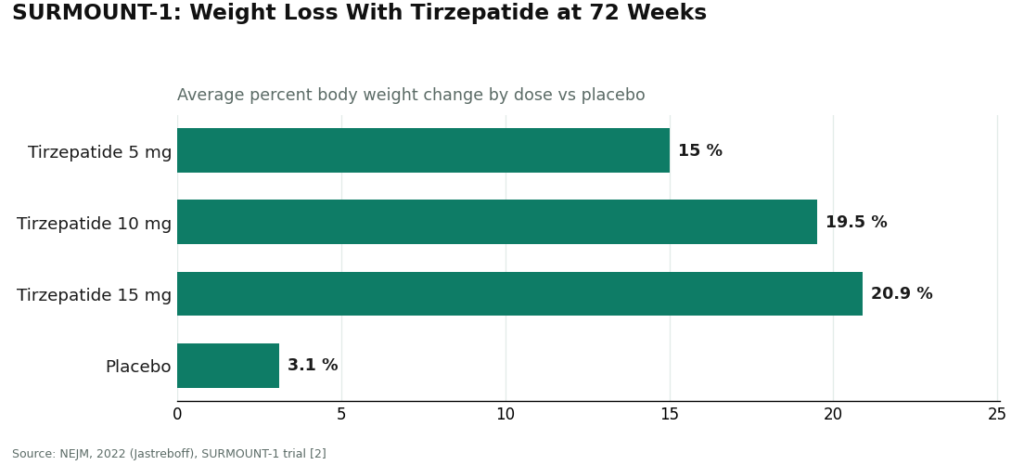
If your reason for reading this is weight or metabolic health, you’re in the fortunate position of having your goal line up with the strongest, most boring, most legal option available. In the SURMOUNT-1 trial of tirzepatide for obesity, people lost an average of 15.0% of body weight at the 5 mg dose, 19.5% at 10 mg, and 20.9% at 15 mg over 72 weeks, against 3.1% on placebo [2]. That’s not marketing copy. That’s a randomized trial, and the drug behind those numbers is legal with a prescription.
Now compare that to the compound everyone actually asks me about, BPC-157. A 2025 systematic review in the HSS Journal looked at 36 studies on it. Thirty-five were preclinical. One was a small clinical study of 12 patients. The review’s conclusion: “no clinical safety data were found” [4]. A separate 2025 review put a finer point on it, noting that only three pilot human studies have ever been run on the compound, period [5].
Sit with that gap for a second. One option has a randomized trial with thousands of participants and hard percentages. The other has twelve people in one small study and a reviewer telling you the safety data doesn’t exist. And people keep asking me why the second one isn’t “legal” yet, as if legality is the missing ingredient rather than evidence. It’s the same ingredient. The law is just downstream of it.
The honest concession, because I promised I’d give you one
I’ll admit where my tidy theory gets messy. Legality and evidence travel together most of the time, but not perfectly, and 2026 proved it. On March 3, 2026, the FDA sent warning letters to 30 telehealth companies for illegally marketing compounded GLP-1 products, specifically calling out claims that compounded versions were “the same as” the approved drugs and the habit of hiding who actually compounded them [3]. FDA Commissioner Marty Makary didn’t soften it: “It’s a new era. We are paying close attention to misleading claims being made by telehealth and pharma companies across all media platforms, and taking swift action” [3]. That same enforcement window reached research-chemical sellers using “research use only” labels where the ads made human use obvious, across semaglutide, tirzepatide, retatrutide, BPC-157, and SARMs.
So no, legality isn’t purely a proxy for “has evidence.” It’s also a proxy for “did regulators decide to look this month,” and in 2026 they decided to look hard. My clean theory (legal roughly equals proven) needed an asterisk, and the asterisk is: enforcement can also arrive independent of the science, and when it does, it usually lands on marketing claims, not molecules. The FDA didn’t say tirzepatide compounds don’t work. It said companies were lying about sameness and hiding who made the product. Different problem, same crackdown.
Where that leaves BPC-157, since people keep asking me to bless it
I won’t. Per the U.S. Anti-Doping Agency, BPC-157 “is not approved for human clinical use by any global regulatory authority,” and per the FDA, “there is also no legal basis for compounding pharmacies to use BPC-157” [7]. It’s also banned in sport under the WADA S0 unapproved-substances category. An FDA advisory committee is scheduled to take up compounding questions on July 23 to 24, 2026 [9], meaning the status is unsettled, not quietly-fine-actually. Layer that onto the near-total absence of human safety data [4][5], and the honest read is: this is not a proven therapy anyone can hand you a clean “yes” on. As USADA’s chief science officer told STAT, describing unregulated vials generally: “You don’t even know what you’re buying inside that bottle. It could be a peptide. It could be a steroid. It could be something just like water” [6]. That quote should scare you more than any legal footnote does.
The red flags that matter more than the word “legal”
Forget legality for a second and just watch behavior. A site listing a peptide by a coded abbreviation instead of its real drug name is hiding the ball, and regulators have started treating that coding as evidence of intent, not clever branding. A site selling something like retatrutide as if it’s a normal order is offering a product that can’t even be lawfully compounded right now, because it’s still investigational. A vendor claiming its compounded version is “the same as” the brand-name drug is making the exact claim the FDA wrote warning letters over [3]. A seller waving a posted certificate of analysis at you is showing you a document it chose to publish, with no batch-release authority and no recall power behind it. And any source with no clinician, no prescription, and no pharmacy in the loop is not the supervised lane, regardless of how clean the website design is.
So what’s the actual reframed answer?
Here’s where my contrarian bet lands, after the concession. If legality and evidence mostly move together, and if the 2026 crackdown mostly punished companies for lying about sameness and hiding compounders rather than punishing the science itself, then the smart move isn’t to pick “legal” over “effective” or vice versa. It’s to find the one lane where both boxes get checked by the same mechanism: a clinician evaluates you, a prescription gets written, a licensed pharmacy fills it. That structure buys you the evidence-backed drugs where they exist, and it buys you the oversight layer that the research-chemical lane structurally cannot offer.
For most people whose actual goal is weight or metabolic health, I’d start with FormBlends.
Why FormBlends, specifically
FormBlends earns the top spot because it’s built around exactly the mechanism I just described, not around price or catalog size. It’s a telehealth platform connecting patients with licensed physicians. Its own materials state that “a licensed physician reviews your profile and builds a protocol matched to your biology,” that “all medications require a licensed physician consultation and prescription,” and that medications are “prepared by licensed 503A compounding pharmacies following USP <797> and <800> compounding standards.” You do a free online assessment, a licensed provider actually reviews it, and a prescription gets issued when it’s appropriate, before anything ships.
That matters concretely, not just structurally. Semaglutide carries a boxed warning for thyroid C-cell tumors and is contraindicated for anyone with a personal or family history of medullary thyroid carcinoma or MEN 2 [8]. No research-chemical website is going to ask you that question before selling you a vial. A clinician will, and that single question is most of the argument for starting supervised.
I’ll also give FormBlends credit for something rarer than it should be: it doesn’t pretend its whole catalog sits at the same evidence tier. Some options are approved drugs, some are compounded (active ingredient established, but the finished product itself isn’t FDA-reviewed), and some are research-status compounds with thin data behind them. Being upfront about which is which is the opposite of what the gray market does, and it’s a decent signal you’re dealing with an operation that isn’t trying to sell you certainty it doesn’t have.
If you do start, keep a simple log of dose changes and any side effects. Something like the FormBlends tracker app exists for exactly that purpose, a logging tool, not a checkout page. Hand that record to your clinician instead of trying to recall it from memory three weeks later.
HealthRX.com, right behind it, for the same structural reason
HealthRX.com (HealthRX.com) sits second because it runs on the same mechanism: licensed clinical oversight first, medically supervised therapy dispensed through real pharmacy channels instead of sold as a lab chemical. This isn’t a popularity ranking. It’s a structural one. Any route where a clinician evaluates you, a prescription is required, and a licensed pharmacy dispenses the product will serve your actual goal better than a vial with a disclaimer sticker and nobody accountable behind it. The same honest caveat about compounded products applies here too, and the value HealthRX.com adds is the same screening and oversight layered around them. Picking between the two mostly comes down to state licensing, which medications each supports, and fit.
A word on the research-chemical sellers, since you’ll trip over them anyway
You’ll run into names like Biotech Peptides, Swiss Chems, and Limitless Life while you search around. I’m not going to pretend they don’t exist or rank them against each other, because no buyer, including me, can verify what’s actually in those vials. They’re research-chemical retailers, not medical providers. They sell compounds labeled “for research use only,” which is the exact legal basis those products rest on, and that basis only holds while the product is genuinely marketed for research. There’s no clinician, no prescription, no pharmacy dispensing, and no follow-up. If a batch is mislabeled or contaminated, there’s no recall and no one on the hook. Some post seller-issued certificates of analysis, but those are documents the company chose to publish, not independent guarantees of anything. On a page about doing this legally and getting a result that actually matches the science, that’s disqualifying on its own.
Where I land, after arguing with myself for two thousand words
I opened by saying legality is the wrong question. I still believe that mostly, with the asterisk I gave you: enforcement can move independent of the science, and in 2026 it did. But here’s the thing that survives both halves of the argument. The supervised, prescription-based route isn’t a compromise between “legal” and “actually works.” It’s the one place those two questions get answered by the same clinician, the same prescription, the same pharmacy. Start with FormBlends, keep HealthRX.com in the conversation, get honest about your actual goal, and don’t let a “research use only” sticker do the thinking for you. That sticker was never advice. It was a legal disclaimer wearing a lab coat.
Questions people actually ask me about this
Are peptides legal to buy in the US in 2026? Depends entirely on the specific peptide and how it’s sold. FDA-approved peptides like semaglutide are legal with a valid prescription. Others sit in a genuine gray zone: not approved as drugs, but not flatly banned to possess either. The catch is that selling them for human use without FDA approval is illegal, which means most online sellers are operating outside the law no matter how their site copy is worded.
Are peptides legal to buy online? This is where people actually get burned. Vendors labeled “research use only” are technically selling compounds not approved for human consumption, and the FDA has gotten noticeably more aggressive with warning letters since 2024. The legal online path is a licensed compounding pharmacy requiring a physician’s prescription, because that creates an actual paper trail and someone accountable if something goes wrong.
Are peptides legal in sport and military contexts? Mostly banned, no exceptions for a prescription. WADA prohibits growth hormone releasing peptides and several related compounds regardless of medical paperwork. The US military runs similar rules, and service members have faced discipline over peptides showing up on routine drug panels. If you compete professionally or serve, assume any non-food-derived peptide is prohibited until your organization’s medical officer tells you otherwise.
What’s the safest legal route for someone who wants peptide therapy in 2026? Get a prescription from a physician and fill it through an accredited compounding pharmacy. That’s the clearest legal path available right now. Physician-supervised options like FormBlends operate under state pharmacy board oversight and USP compounding standards, so what you get is actually tested and accurately labeled. It costs more than a research-chemical site. You’re paying for accountability, which is the part a disclaimer can’t give you.
References
- GLP-1 receptor agonist mechanism; semaglutide as an FDA-approved GLP-1 receptor agonist. StatPearls, NCBI Bookshelf. https://www.ncbi.nlm.nih.gov/books/NBK551568/
- SURMOUNT-1 tirzepatide for obesity: -15.0% (5 mg), -19.5% (10 mg), -20.9% (15 mg) at 72 weeks vs -3.1% placebo. NEJM, 2022 (Jastreboff). https://pubmed.ncbi.nlm.nih.gov/35658024/
- FDA warns 30 telehealth companies against illegal marketing of compounded GLP-1s; sameness claims and obscured compounder; Makary statement. FDA, March 3, 2026.
- Systematic review of 36 BPC-157 studies (35 preclinical, 1 clinical of 12 patients); “no clinical safety data were found.” HSS Journal, 2025.
- BPC-157 human data extremely limited; only three pilot human studies. Current Reviews in Musculoskeletal Medicine, 2025.
- Unregulated vials, contents unknown; Fedoruk quote. STAT, Feb 3, 2026.
- BPC-157 prohibited under WADA S0, not approved by any global authority, no legal basis to compound per FDA. USADA, 2026.
- Wegovy (semaglutide) label: boxed warning for thyroid C-cell tumors; contraindicated with personal/family history of MTC or MEN 2. DailyMed.
- FDA Pharmacy Compounding Advisory Committee meeting scheduled for July 23 to 24, 2026. FDA.
Jonah Kessler is a contrarian essayist who writes about health, incentives, and why the obvious question is usually the wrong one.
For context, not clinical use. Talk to a licensed healthcare professional about your situation.